Flared Jeans vs Bootcut: Which Retro Silhouette Suits You?
There are two pairs of jeans that get called retro before any others: the flare and the bootcut. In a photograph they can look almost identical. On a body, they behave completely differently. One widens steadily from the knee; the other only opens just enough to sit over a shoe. Knowing which line you are looking at — and which one you actually want — saves a lot of dressing-room disappointment.
The Leg Opening Tells You Everything
Take both pairs off the rail and look at the hem. A bootcut is cut fairly straight through the thigh, then angles out gently from the knee. Its hem usually measures somewhere between about 16 and 19 inches around. A flare keeps a similar top half but opens far wider — 20 inches or more — and the kick is bolder. Bell-bottoms go further still, often widening from the mid-thigh.
A quick test: lay the jeans flat on the bed and fold the hem as if you were tidying them away. If it settles into something close to a rectangle, that is a bootcut. If it refuses to lie flat and leaves a triangle of fabric, you are holding a flare.
Both cuts now come in rigid cotton and in stretch denim. Rigid holds the shape you saw on the hanger; a little elastane gives a smoother line over the seat and the knees. Neither is better — it depends on how you want the fabric to behave by four in the afternoon.
Rise, Waist and the Era You Are Channelling
The rise is where the two cuts part company historically. The flares that defined the late sixties and seventies sat high, at or above the navel, with a long inside leg and often a wide waistband. The bootcuts that took over in the nineties and early 2000s sat lower, around the hip bone, and were worn with pointed boots and plain tops.
That history still shows in the fit. A high-rise flare pulls the eye upward and creates one long unbroken line from waist to floor — the effect most people are after when they reach for a flare. A low-rise bootcut shifts the balance: longer torso, shorter leg, a silhouette that reads as Y2K rather than seventies.
If you go high, check that the waistband genuinely meets your waist. A gap at the back is the most common complaint with high-rise denim, and it is worth having the waist taken in rather than living with it.
A Short History in Four Cuts
- Late 1960s to 1970s: high-rise flares and bells in heavy denim, worn with platforms, tunics and cheesecloth.
- 1990s: the bootcut becomes the default jean — fitted thigh, modest opening, pointed heeled boots.
- Y2K: low-rise bootcuts and flares in stretch denim, often embellished, paired with wedge trainers.
- 2010s onwards: skinny jeans dominate and then fade; cropped and high-rise flares return to the high street.
Which Cut Suits Which Shape
Shorter frames and short torsos
Length is everything. A flare that begins at the knee and finishes cleanly at the ankle will make you look taller than a wide bell that starts higher up. Keep the wash similar top to bottom and go easy on heavy fading across the thigh. Hem the jeans to wear with the shoes you actually own — a stalk of ankle showing under a flare usually shortens the leg.
Tall frames
You can carry a big flare, 24 inches around and upwards, without being swamped by it. A mid rise and a long inside leg work well. Bootcuts can look slightly mean on a tall frame unless the opening is generous, so check that the hem properly covers the top of your shoe.
Curvy hips and thighs
A bootcut is often the easier of the two, because the opening balances the width of the hip without adding volume anywhere else. Look for a higher back rise so the waistband sits comfortably when you sit down, and a touch of stretch to keep the seat smooth. If you want a flare, choose one that starts at the knee rather than the thigh — a flare that begins high up exaggerates the very thing you are trying to balance.
Straight or athletic builds
Flares and bells are a gift here. They add curve and movement to a straighter line, especially in a mid or high rise with a defined waistband. A bootcut will look neat and understated, which is sometimes exactly what you want.
Shoes, Hems and Finishing Details
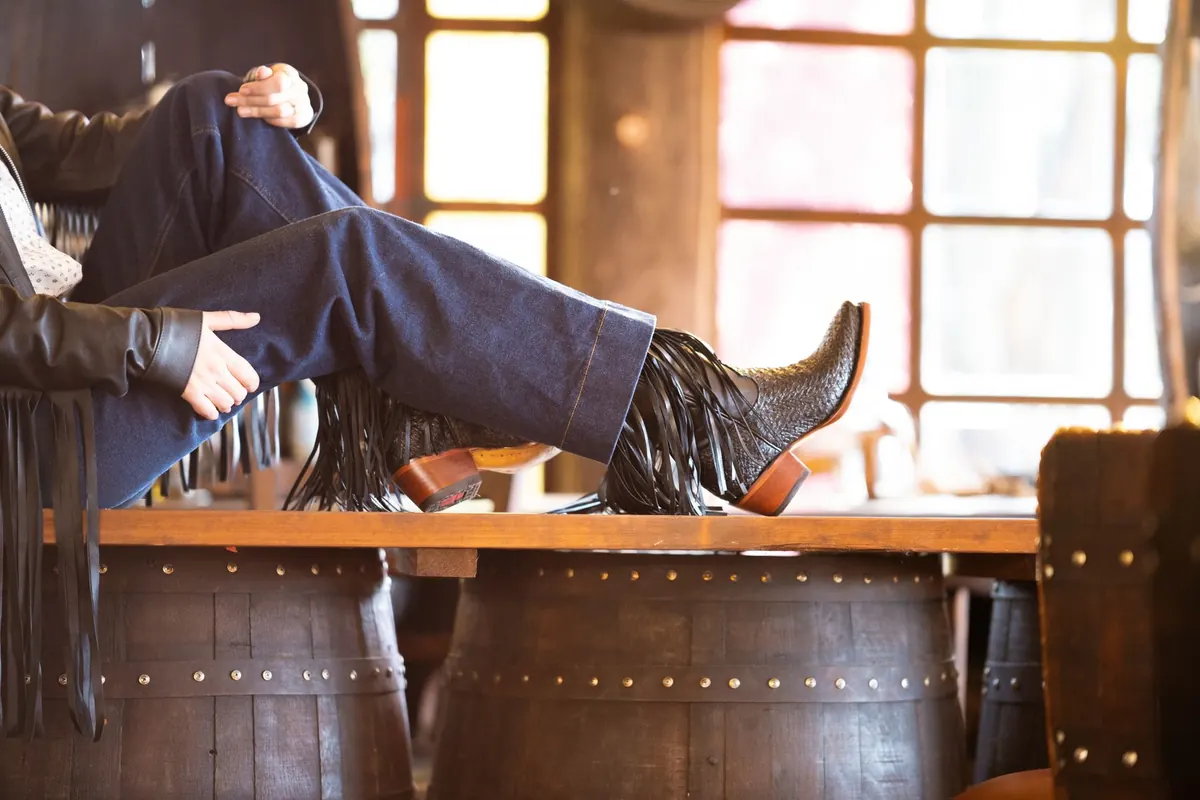
The cut only works with the right shoe underneath it. A bootcut wants a little height or bulk: a heeled boot, a stacked trainer, a Cuban heel. A thin flat sandal can leave the hem looking limp and indecisive. A flare takes chunky trainers, platform sandals, wedges and cowboy boots happily — the extra fabric at the ankle is the point rather than a problem.
Hem length matters as much as the opening. With a flare and a heel, the hem should break just at the top of the shoe with a small crush at the front. With a bootcut, the back hem should skim the floor. Cropped flares are a separate case: they need ankle boots, clogs or a chunky loafer to stop the gap reading as an accident.
Fitting Room Checklist
- Take both cuts into the fitting room in the same size. Comparing from memory never works.
- Lay each pair flat and measure the hem. Under about 19 inches is bootcut territory; over 20 inches, you are in flare.
- Note where the outward kick begins. Knee or below looks flattering; mid-thigh is a statement.
- Sit down, cross your legs, then stand up again. The waistband should neither dig in nor gape.
- Wear the shoes you will wear most. If you have none with you, ask yourself whether you own anything with height or bulk.
- Look at the side view, not just the front. That is where rise and leg line give themselves away.
The Short Answer
Choose a flare if you want length, drama and movement around the ankle, and if your wardrobe already leans towards platforms, wedges or chunky trainers. Choose a bootcut if you want a jean that disappears into an outfit, slips over boots and flatters a lower or mid rise.
Most people end up with both, and there is no rule against it. Start with the pair that matches the shoes you reach for most often, get the hem altered to your height, and you will wear them far more than the pair that only looks good in a photograph.
Photo: Mike C / Pexels


You Might Also Like
From Gloucester Road's charity-shop trail to Sunday swaps in Southville, here's how to hunt, repair and trade retro fashion finds across Bristol.
A practical guide to the vintage cues — silhouette, fabric, colour and accessories — that make an outfit read retro rather than fancy dress, plus how to style them for everyday wear.